Thursday, July 12, 2012

A Rizal Relic in Luneta's Rizal Park


Did you know that right in Luneta, near the Rizal Monument, there's a drinking fountain donated by the people of Wilhelmsfeld, Germany to the Filipino people?   It was used by our national hero, Dr. José Rizal in 1886 when he lived in their small village near Heidelberg.

Background

Recently, I created a very short video about my latest trip to Rizal Park, Luneta, Manila describing this much forgotten Rizal relic titled The Wilhelmsfeld, Germany drinking fountain used by Rizal. I posted it on Facebook.

http://tripwow.tripadvisor.com/tripwow/ta-05b4-62c4-a2b5?share=1&cs=p&lb=1

One cannot believe the deluge of comments I received from Facebook viewers (from around the world including the Philippines, Spain, Italy, Germany, Netherlands, Belgium, Middle East, Canada and several states in the US) wanting to know more about this Unknown Rizal Relic.  Earlier, I also created a four-page Newsletter titled Rizal's Wilhelmsfeld Drinking Fountain in Luneta, Manila. My good friend, Sir Rainer J. Weber, Commander of the Knights of Rizal, Wilhelmsfeld-Heidelberg chapter, requested me to transform that Newsletter into a blog where interested followers could just visit.

So here goes.


You've Never Heard of It, but There's A Living Rizal Relic in Luneta!


Restored in 2011 in time for the Rizal Sesquicentennial

The drinking fountain was installed at Rizal Park in 1964, cleaned and repaired in 1994, and refurbished and painted in 2011.

It's running dry and is non-functional. 

To the teachers of Rizal courses: "Be sure to include this material in your lesson plans."


Totally in the Dark


Why was I never aware of this Rizal's Drinking Fountain till I visited Wilhelmsfeld, Germany in 2011?  Why have I not been taught, throughout my schooling days and throughout my Rizal reading assignments, about the presence of this important historical "Relic" at Rizal Park?   


I pride myself in being a Rizalist yet I have neither known nor read any article about this Fountain.  Have you?  (I'm addressing you, my dear readers and blog followers.) 

Had this Rizal Relic ever gained an inch of print anywhere? Shame! This blog is an attempt to answer this stinging reproach.


A Living Monument


Friday, 27 April  2012.
Rizal Park, Luneta, Manila, Philippines

I arrived from San Francisco on a  PAL direct flight  and checked in at  Manila Hotel.  From there I walked over a block away to Luneta and observed the spiffy Philippine Army’s Special unit in revolutionary rayadillo uniform changing guards at the Rizal Monument. Very Impressive! I met a service park employee and talked to him.


“I came all the way from San Francisco, California to see a special place in Rizal Park. Where’s the Rizal living Monument?”


Park employee:  Patay na po siya. (He’s dead.) 

Me:   Well, isn’t there a drinking fountain where Rizal used?


Park emp.: Oh, yes, over there on that side, po. France donated it.


Me.  Not exactly. Wilhelmsfeld, Germany donated it.


Park emp.: Well, OK, po. It’s a replica.


Me.  Sorry, it’s the original fountain, a living monument."


Note: The Rizal Park 's Tourist Police seems unaware of Rizal’s Wilhelmsfeld Drinking Fountain within their own premises.


A Rizal Park In Wilhelmsfeld, Germany


Wilhelmsfeld is officially Germany’s “Noli Village”   where there’s a Rizal Street and a Rizal Park.  An  expressive-looking freestanding bronze statue larger than life graces a pedestal surrounded by a pool of dancing waters.  This is the only hero’s statue that I know of where one can pose beside it.


 D. José Rizal's statue standing  at ground level.  Wilhelmsfeld Rizal Park.


In this vicarage house,  Rizal finished the last remaining chapters of his novel Noli me Tangere. The simple three floor level vicarage has a Rizal historical marker and a Rizal street sign. The village council and Knights of Rizal chapter celebrate Rizal Day, December 30th  and Rizal's birthday, June 19th yearly.


In Wilhelmsfeld, as a tool for perfecting his German language skills, Rizal read Schiller’s William Tell and started translating it in Tagalog. He finished translating the full play six months later when he moved to Leipzig. 


He created a comic strip in German for Friedrich, Pastor Ullmer’s 13 year-old son. This comic strip is historian Dr. Ambeth Ocampo's favorite Rizaliana.


Rizal learned religious tolerance in Wilhelmsfeld by joining the regular weekly discussions in theology with Pastor Ullmer, the protestant vicar, and the pastor's friend, Father H. Bardoff,  the Catholic priest of the nearby town.


A Historic and Spiritual Experience 


At Luneta’s Rizal Park, Manila, Philippines, one can see great and inspiring memorial statues.  The exception is this fountain. It’s not a memorial. It’s an actual relic.  Only in this fountain can one feel Rizal’s personal aura. Just imagine--he drank from this very spout. He touched this sandstone pillar. With his fingers, he traced the intricate designs inscribed on its sides. He wondered at its symbolism. He noted the date: 1826 and appreciated its old history. He admired the top finial pine cone.  


He actually sat on the trough’s rim and quenched his thirst from this very fountain. 


Wow, Rizal must have cupped his hands to drink fresh spring water at this very spot.
I was eager to see this drinking fountain that Rizal used while he was in Wilhelmsfeld.  Rizal was studying at Heidelberg University doing clinical opthalmology practice with Heidelberg University's Professor Dr. Otto Becker.  During one of  his walks on Philosophenweg, he met Pastor Karl Ullmer of Wilhelmsfeld, a village 13 kilometers away, and found a friend and a landlord.  Moving out of Heidelberg and settling in the village, Rizal would walk that distance (3 hours trek) though the Odenwald forest. When he arrived home exhausted, the most welcoming sight as he entered the vicarage gate was this drinking fountain.  


Don’t miss this historic moment. Get thee to this unique and significant Rizal Park relic in Luneta and savor a monumental and spiritual experience!


How the Fountain Found its Way to Luneta

Penélope with Sir Rainer J. Weber

An Interview with Sir Rainer J. Weber,  Chapter Commander, Knights of Rizal (KCR), Wilhelmsfeld-Heidelberg.  (06-09-2011). 


PVF: Was the drinking fountain a pump... a Philippine rural “poso”?


RJW: No, it wasn’t pumped. It was running water from a nearby well that flowed into the sandstone fountain inside the Pastor’s garden wall for his family to drink and use. It had a lost trough outside the wall for the locals, farmers, and their cattle to use. It had been out of service for many years because the wooden hose system had decayed over time. Since WWII, it had run dry. When a new vicarage entry gate was built, it was moved into the garden with no function except as a decoration.


PVF: Whose idea was it to give it to the Philippines?
Gene Cabrera was a Philippine  artist/ journalist who visited Wilhelmsfeld, 1963.


RJW: It was my father’s guest, the Philippine artist Gene Cabrera who came to visit in October 1963. He eyed the  drinking fountain and realized its historical significance. (See Cabrera's sketch.)


My father, Pastor Gottlob Weber, took on the idea further and convinced the higher Church authorities, who owned the item, to donate it to the Filipino people.  In September 1964, the fountain was shipped off to Manila via Philippine Air Lines. Voluntary contributions poured in. 
Pastor Gottlob Weber and Filipino guests, Wilhelmsfeld,1963.


On December 30th 1964, the fountain was formally handed over to the Filipino people by H. E. von Stechow, the German Ambassador.  Attending were the Ambassador's wife, Minister for Cultural Affairs  Pura Castrence, Mr. Gene Cabrera, Mrs. Mendez and her husband Foreign Secretary Mauro Mendez.


PVF:  How long did the project take?


RJW: It was all a matter of 14 months from the conceptual planning to the Luneta installation.


PVF:  How did your father, Pastor Weber, get involved in all these?


The empty spot where the fountain originally stood inside the vicar's garden, Wilhelmsfeld, Germany.
RJW:  Since Dr. Paz Mendez conducted her Rizal research in Wilhelmsfeld, my father read a lot about Rizal and his works and fell in love with him. Soon many officials and Philippine dignitaries came visiting the vicarage. My dad received them all. He even kept a signature guest book. Of course, when he was invited as a special guest to the Rizal Centennial in 1961, he was all fired up. So when the fountain issue came up he was full of enthusiasm and initiated the project heartily. Neither the Philippine Government nor Mrs. Mendez of the Philippine Historical Commission initiated it.


PVF: He was an extraordinary Rizalist, and so are you as I find us united in spirit with Rizal’s legacy.

RJW: Yes. Thanks.


IN MY HUMBLE OPINION 

Penélope V. Flores 


Walking 500 yards off to the right of the Rizal Monument, I noted the attractive path leading southward to the Rizal Fountain area.  The slightly raised graduated geometric cement platforms give the fountain good visibility. I also like the sloping angles of the background wall. It contributes a solid strong structural dimension to the fountain. It has clean lines. The surrounding crowning trees provide cool shade and help muffle Roxas Boulevard’s street sounds.
The fountain is painted brown umber and  the background wall in burnt sienna.  In my humble opinion, the fountain and the retaining wall have no color separation. From a distance the whole set blurs into one.
I expected an old natural red sandstone fountain, but it was smoothed over with paint that shouted “Look at me, I’m brand new!” Didn’t Rizal actually drink from here in 1886 when the fountain was already 60 years old? (Note the date on the fountain’s side: 1826.) I referred to the 1963 drawing and picture. That fountain definitely had character.  It was naturally ensconced within a bowery garden whereas now, in the renovated site it stands in a garden of concrete.  Inadvertently, I think the 2011 restored fountain suffers a misrepresentation image. 


Anyway, I’m happy. I had seen the Rizal relic. There it is in its full glory. 
I gathered my relatives and friends and gave the fountain’s historical story and then requested them to pass it on. 

The plaque acknowledges the contribution of Wilhelmsfeld to  Rizal Park.
We need to let people know about this true Rizal living artifact. It should not be kept hidden in a veil of ignorance and remain undisclosed for so long.  
It’s encouraging that President Benigno Aquino III gave his National Rizal Day Address on Rizal’s Wilhelmsfeld Drinking Fountain site on 30 Dec. 2011.  Kudos to him since it gained a few inches of print in the news.  However, Isn't it a shame that even the leading Philippine newspapers mis-identified the fountain as coming from Heidelberg when the correct information should have been Wilhelmsfeld!  


It's like saying the Rizal Monument is located at Pasig, not at Manila.


Sad to say, Philippine journalists and newspaper reporters have so little information about this important Rizal Relic.

Here is my humble message to teachers everywhere, Knights of Rizal Chapters, educational institutions, government and private agencies: 

"As an initial outreach initiative, let’s use this venue: Rizal's Wilhelmsfeld Drinking Fountain, to create and promote our Rizal events and community activities. It’s about time we elevate the public’s consciousness.   Maraming Salamat pô."


Excerpts from Chapter 7, Noli me Tángere.  


As you read Rizal’s Noli me Tángere’s Idyll in an Azotea, be aware that he was describing the pastoral scene from his Wilhelmsfeld experience and point of view.

Maria Clara asked Crisostomo Ibarra if he ever thought of her during his sojourn in foreign lands.  Ibarra replied:  

“How could I forget you...always, in Germany in the late afternoon when I roamed through the thick forests peopled with the fantastic creations of her poets and the mysterious legends of her past generations, I recalled your name, and when the villagers, returning from the fields in the distance would sing their popular songs, to me they seemed to harmonize with my inner voices singing for you…” Rizal.  2006. Noli me Tángere,  Lacson-Locsin (trans.)  Q.C.: Ateneo Press, p 45.  

Rizal roamed through the thick forest of the Odenwald while walking from Heidelberg through the valley on to Wilhelmsfeld. From Rizal’s window at the vicarage, he could hear the farmers’ rippling, lusty singing voices returning home from the fields. They would stop in front of Rizal’s house where their cattle would drink from the running water trough.

When I visited the village in 2011, I admired, from a local friendly and welcoming restaurant  “Talblick", the panoramic view of the valley and of the Odenwald forest that Rizal loved.


Penélope’s interpretation of Rizal’s Odenwald forest trek. Oil on canvas. 13 x 18 inches. 


Wednesday, May 23, 2012

Rizal's Wilhelmsfeld Drinking Fountain at Luneta


I just came back from a wonderful trip to Manila where I visited Rizal Park in Luneta to see the celebrated Wilhelmsfeld Drinking Fountain; now refurbished, repainted, and looking spanking new.  Read on.

My own ignorance.

The Wilhelmsfeld Drinking Fountain
Why was I never aware of this Drinking Fountain till I visited Wilhelmsfeld, Germany in 2011?  Why have I not been taught in school and through readings about this Relic in Rizal Park?   I pride myself in being a Rizalist yet I have neither known nor read any article about this Fountain.  Have you?
Had this Rizal Relic ever gained an inch of print anywhere? 

Shame! This blog is the answer to that  stinging reproach.


Pamela,  Predy, Rizal Park Tourist Police, Penelope V. Flores

I observed the spiffy Philippine Army’s Special unit dressed in revolutionary rayadillo uniform changing guards at the Rizal Monument. Impressive! 

I met a Tourist Police park employee and said; 

“I came all the way from San Francisco, California to see a special place in Rizal Park. Where’s the Rizal living Monument?”
Park emp.:  Patay na po siya. (He’s already dead.) 
Me:   Well, isn’t there a drinking fountain which Rizal used?
Park emp.: Oh, yes, over there on that side, po. France donated it.
Me.  No, Wilhelmsfeld, Germany gave it.
Park emp.: Well, OK, po. It’s a replica.
Me.  Sorry, it’s the original fountain, a living monument. 

Note: Even Rizal Park employees seem unaware of Rizal’s Wilhelmsfeld Drinking Fountain within their own premises.


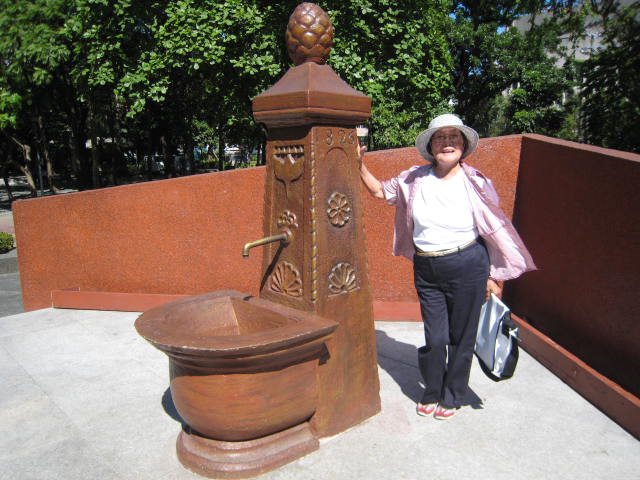
Ida Flores, at the Rizal Drinking Fountain, Rizal Park, Luneta , April 2012.
The Rizal Fountain is backed by a sloping retaining wall.  It must have simulated the Vicarage's brick wall. However, the original drinking fountain in Wilhlemsfeld had green bowers and creeping ground foliage around it.  This one is surrounded by concrete!
This is the drinking fountain at Pastor Karl Ullmer's Vicarage where Rizal  lived (1886), Wilhelmsfeld, Germany.

It was donated by the Wilhelmsfeld Village to the Filipino people on 30 December, 1964, Luneta.  I like the clean imprints of the medieval fountain design. 


The fountain is of natural reddish sandstone, but the Rizal Park officials painted the fountain burnt sienna and the wall behind it, brown umber.  Thus the wall and fountain almost blend together from a distance.  
 
The local farmers quenched their thirst from this very fountain as they came home from work.  So did their cows. I would like to imagine that José Rizal must have sat on this very rim.

 Rizal must have admired the idea of a pine cone finial, so pleasing to his artistic eye, that topped the fountain base.


Penélope, that fountain had dried up during WWII. It was just sitting as a decoration on the vicarage garden when it was donated to the Philippines at the 1964 Rizal Centennial.
The fountain has 1826 inscribed on its side.  That means it was 60 years old when Rizal used it in 1886.  This fountain is the only authentic relic in Rizal Park.  It's not a memorial as the other monuments are in Rizal Park.  It's a living monument.  It's the real fountain where our national hero drank from, where his fingerprints were embedded in it's water spout, where his fingers traced the scalloped designs and floral patterns by its base, and where his spiritual aura still lingers.

Go there and find time to relish Dr. José Rizal's presence.  

Get thee to this living monument when you visit the Rizal Monument next time.  It is about 500 yards south from the monument itself.  Get off at Roxas Boulevard in front of the familiar Rizal Monument.  Walk straight up to Rizal's statue, then turn right and follow the path.  It is defined by several concrete platforms.  Almost nobody knows about it.  

It's about time we raise our consciousness about this Rizal living legacy: the Wilhelmsfeld Drinking Fountain.  


Where is Wilhelmsfeld, and why is it important among Rizal scholars?  
Wilhelmsfeld is about 13 kilometers from the university town of Heidelberg.  Rizal came to Heidelberg  University to study ophthalmology and to gain clinical experience in using the new eye medical instrument:  the ophthalmoscope first used  in Heidelberg. He studied under Professor Dr. Otto Becker.  The clinic where he trained now has a Rizal historical marker.  His apartments at Heidelberg University also carry historical markers. 

Rizal perfected his German language skills here.  He had a unique way of studying a language.  He read Schiller's play:  William Tell and then  translated the whole 68 pages in Tagalog. Talk about focus and sheer persistence!

Page 5 of Rizal's translation in Tagalog of Schiller's William Tell


Important to note is that Rizal finished the last chapters of Noli me Tangere at the vicarage in Wilhelmsfeld. This village is officially called "Noli Village".  It has a Rizal Park, a Rizal Street and the village council and local Knights of Rizal chapter celebrate 30 December, every year.  

Well, only in Wilhelmsfeld!  


Thursday, April 19, 2012

Did Dr. José Rizal Ever Receive an Insulting, Scathing Letter?


Did Dr. José Rizal Ever Get a Good Scolding Letter?  Answer:  Yes
Why?   He asked for it.
Who sent it?  An anonymous friar from Manila.

José Rizal: Miscellaneous Correspondence, National Historical Commission of the Philippines, 2011
On 15 February 1888, José Rizal received a  scolding letter from Manila signed “A Friar” addressed familiarly "To Pepe.”

The letter was a virtual assault on Rizal’s character and integrity.  It says, “I am duty bound to send you these lines whether you like them or not.”  Then the catalogue of character assassination began:

You are very ungrateful.
…You have an atom of honesty.
…You attack cruelly without reason and without basis.
…You are becoming more and more stupid and vicious.
…You are totally submerged in the chaos of ignorance.

Of course, the friar reminds Pepe of what his religious order had bestowed on Rizal:

…You have repaid with blackest ingratitude the priceless benefits, which you received, from us.
…You owe us much of your education.
…What we are doing now is inhumanely impossible in bringing you out of ignorance.

The letter continues with a blame game involving God and Nature:

…We are not God that we could make bright minds out of nothing.
…If the fault is not yours, blame God and ask for an explanation of your backwardness.
…Blame Nature, which created you with innate incapacity.
If you are miserable than before, it is not our fault.


This anonymous writer calls the Government  “the monster” and the culprit in influencing Pepe’s atrocious behavior:

That monster claims to be your father;

…That Government which is duty bound to give you education, riches, and
solely responsible for you before humanity and God is;
…Destroying you,
…Spoiling you,
…Grabing your bread,
…Little by little annihilating you,

The anonymous author urges Pepe to attack this Government.

You should attack it severely.
…If you do that you shall have us at your side.

This letter becomes more and more interesting because it attributes Rizal’s negative views to his readings.  

…The abuses and insults you hurl to us came from your trashy books. 

At that time, Rizal was reading Voltaire, Rousseau, Zola and other French celebrated intellectuals who, through their works, defined the meaning of  "The Age of Enlightenment."  
Rizal's sketch of Voltaire statue


Marble statue, Voltaire, Louvre Museum


Rizal was also working on the Tagalog translation of Schiller's call for freedom in "William Tell".


Page 4 of Rizal's  Guillermo Tell Tagalog translation


And finally, to add insult to injury, this anonymous letter-writer challenges Pepe to a duel!

If you are offended, challenge us and we shall accept it.
…We are no cowards as you are.
 …Not discounting the possibility that a hidden hand may put an end to your life.

And piously, the “Friar” ends with:
…Amen.
     
                                                ♦♦♦♦♦

 We could almost hear Rizal roar with laughter.  He was delighted to receive this kind of letter because he actually asked for this letter.  Earlier, he had requested his friend, Sixto Lopez, to send him "anonymously" a very insulting letter for four reasons:

1)    He knew that his letters were being opened and censored.
2)    He wanted to satirize the censors by giving them a dose of their own medicine.
3)    The letter expresses exactly the friars' general  attitude toward the educated Filipinos or the "ilustrados." And most importantly,
4)    By receiving this kind of letter, Rizal is reassured that all his future letters will be delivered to him promptly.


Reference: Jose Rizal’s Miscellaneous Correspondence, NHCP, 2011, pp. 96-97. 


Thursday, November 24, 2011

Did Dr. José Rizal Ever Enjoy Visiting a Jailhouse?

Question:  Did Dr. José Rizal  ever enjoy a visit to a jailhouse?
Answer:  Yes, he did!

We're not talking about Fort Santiago, his own jail cell. And he surely did not enjoy it there. He visited the jailhouse of Santa Cruz,  Laguna, where he was full of anguish. His mother. Teodora Mercado Alonzo was accused of poisoning a person. It appears Doña Teodora tried to save her cousin's marriage by intervening in their domestic quarrel.The authorities jailed her based on the accusation of the estranged wife of an attempt on her life. After a slow and costly legal appeal, she was exonerated, but then she had suffered two and a half years in jail. He visited his mother in jail during school breaks.

Rizal also learned of several jail houses. In 1890 Paciano and his brothers-in-law were deported to Calapan, Mindoro as Filibusteros. His sisters, Saturnina, Narcisa, and Olympia described in their letters to him the dismal and very isolated jail conditions. With some exceptions, jails are always miserable, dismal, and isolated anywhere. However, in one instance, Dr José Rizal actually loved visiting this jailhouse.  Where was this jailhouse?

It was in Heidelberg, Germany!

In 1886, Rizal arrived in Heidelberg, Germany. He had just finished  ophthalmic surgery internship training with the professor Dr. L. de Wecker of Paris.  He then went to Germany to do more specialized work with the University of Heidelberg professor, Dr. Otto Becker, whose Augenklinik is where ocular fundus research was being conducted. Here Rizal learned the principles of the concave interior of the eye consisting of the retina, the choroid, the sclera, the optic disk, and blood vessels, as seen by means of the ophthalmoscope, a new medical instrument, developed and first introduced in Heidelberg.

Heidelberg, an old world Renaissance town, is known for its religious tolerance, old fantastic ruined castle,  and the oldest university in Germany, famous as a distinguished center of  learning and scientific research. Rizal also advanced his German language skills here.

Rizal's apartment, white building
Rizal’s apartment was on 12 Ludwigsplatz, now Grabengasse. Among other attractions, he found the students' colorful prison house or the Studentenkarzer  only a block awayTotally intrigued and immersed by this institution, he visited it and even wrote about it to his parents.

Photo credit: Rainer J. Weber in dark jacket
Why is there a student jailhouse within the university? Because the university enjoyed its autonomy vis-a-vis the town council. Since the council had no legal jurisdiction over rowdy and noisy university students, the need for self-policing and governance was needed. In a house adjacent to the old university site in Augustinergasse, the University created its own administration for dealing with out-of-control student behavior.

Jail terms were normally meted out for drunkenness, brawls, (sounds familiar?) and dueling among rival members of fraternities. In Rizal's letter dated 26 February 1886, he wrote, "They fight only among themselves, corporation against corporation...many times without any motive...just to test bravery..." [Note: "fraternity" is a modern word.]

Sir Rainer J Weber, the Knight Commander of the Knights of Rizal Chapter in Heidelberg-Wilhelmsfeld, gave me a tour of this prison house. Below are the pictures he took.
At entrance door sign says: "Abandon hope, all who enters." Dante. 
One of the more artistic images.

No space is wasted.

The students' names, days in jail, and corps initials are recorded.


Soot was used for silhouettes.

A photo of a Heidelberg young student. 


One wall inscription said: "One for all, all for one! Because like honest people, we delivered five cobblestones found on the street to the cops by marking them 'found' and throwing them into the guardroom, we are confined here as martyrs to our own honesty."


The walls are packed with proud profiles.
Six days in the Villa Trall room, Karzer


Self-portraits in yellow jackets and red caps.
Regarding the throwing of the cobblestones, the text goes on, "Beware Officer! The hedgehog stings. 2-7 July 1901. Not guilty of course!

u
Most students have encounters with local policemen.


One poet wrote: "If instead of just 5 lanterns,
I'd snuffed full 25 dead,
I wouldn't have served just 2 days,
But rather a full 10 instead."  

Most misdeeds were for vandalism, drinking, and fencing.  The jailbirds used very concise and ironic phrases--perhaps another venue for Rizal's language studies.
 This door was plastered with photos of inmates. Note the sparse furniture.
The average days spent in jail was from 3 to 5 days. Even Mark Twain was fascinated by this prison.  He wrote: "I do not think I ever was in a more elaborately frescoed apartment." The jail house finally closed in 1914, but it continues to be a popular tour sight. In 1886, during Rizal's time, it was enlarged and renovated.

The Stairwell 
In a letter home Rizal described the students thus: "There are five Corp students here and they are Vandalia, Guestfalia, Saxoborussia, Rhenania and Swabia and their respective caps are red, green, white, blue and yellow."

Gray silhouettes bottom right, were from earlier times. 
Rizal's friends were the Swabians (the yellow caps). He played chess with them and twice a week joined them at a beer hall. He was invited to join their frat. Rizal wrote he observed their fencing practice. But Rizal had no time and declined the invitation.

Those incarcerated covered every inch of wall space with their colorful graffiti, making this jailhouse a contemporary tourist attraction. I tried to look for an 1886 graffiti, but there were layers upon layers of painting, obliterating earlier and older ones. In fact, if Rizal could have dared, he would have liked to be jailed in these premises too, so that he could have written his name on the wall. He could have drawn some neat profile of Crisostomo Ibarra of Noli me Tangere on the prison walls.

Sigmund Romberg popularized and romanticized the students of Heidelberg's carousing, fencing and beer-drinking spiels in the screen movie The Student Prince, a 1954 MGM production featuring Mario Lanza singing in the soundtrack. Current university students nowadays are still having fun, still drinking too much beer, still romancing the ladies, but dueling had gone out of style. 

So, when you take a tour of Heidelberg, one of your destinations must be to go to jail! and heed Dante's invocation: "Abandon hope all who enter!" Like Rizal, you will be astounded, impressed, and be captivated by the creative free-spirit of the university students of Heidelberg.


Wednesday, November 16, 2011

Did Dr. José Rizal Ever Use a Cuss Word in any of his Works?

Basic Question  Did Dr. José Rizal ever use a cuss word in his letters and works?

Quick answer:  Yes, he surely did.

Well, he actually used the word:  Damn it!  However it was not in Tagalog. Certainly not in Spanish, nor French, but in German.  It was  Donnerwetter!!! Damned!

Did we find this in any of his letters?  No, not in any of his letters, but in a comic strip he created for Pastor Karl Ullmer’s young son, Fritz.

In the summer of 1886, in Wilhelmsfeld, Germany, in a lovely quiet village, about thirteen kilometers from Heidelberg through a walk across the Odenwald forest, Rizal became the guest lodger at the vicarage of a protestant pastor Karl Ullmer and his wife and children: Etta and Fritz.

Fritz, the boy, was a curious lad who often must have gotten into Rizal’s private space. How did we know this? Pastor Karl Ullmer’s great grandsons, Fritz and Hans Hack said their grandfather, Fritz, told them Rizal had a large Philippine map tacked on to his bedroom wall and that this map attracted his interest so much that he studied it several times (maybe he would sneak into Rizal’s room when Rizal was out in Heidelberg doing his opthalmology practice and attending lectures at the University). Sometimes finding Rizal writing on his desk, Fritz would usually drag him out to gather strawberries, hunt for wild blueberries, or pick woodruff flowers (a twining lily flower that grows in circles around its stem). The Ullmers made Rizal enjoy quiet contentment that he wrote to family and friends how happy he was in Wilhelmsfeld.

Rizal at that time was also busy finishing the last chapters of his novel Noli me Tángere. So, perhaps to occupy Fritz's time, he created a six-frame comic strip of young Fritz and his friend. The boys are shown concocting naughty plots and reaping the natural consequences of their boyish pranks.

Picture yourself as young Fritz Ullmer. You’re an overactive thirteen-going-on-fourteen year old, not yet a grown up but trying to behave like one in a minute and reverting to being a child in the next. That’s the developmental condition of a newly-minted teen. Rizal knew this prototype real well. He had many years of practice with his nephews and nieces by Saturnina, Narcisa, Lucia, Maria, and Olympia. Rizal drew accompanying pictures of his Tagalog translations of the Hans Christian Andersen’s fairy tales for his young relatives. He knew comics was always a great hit.

Rizal drew a comic page exclusively about Fritz, for Fritz. If you were lucky to be the subject of a comic strip before, you would have been as thrilled to death as Fritz was.

Rizal had one of the boys utter a mild curse! This answers my question at the top of this page blog. However, you won’t find this “factoid” if you simply rely on the Rizaliana documents. You see, Big Brother had edited out the cuss word so that we (plebeians)  won’t ever get to see this offending word. The historical gate-keepers want to forever perpetuate the image of a clean national hero in the spirit of high hagiography.  

I, too, am enamored of this charming comics. The same is true for my Rizalista  friends, the Knights of Rizal members from Germany, Sir Rainer J. Weber, and from Belgium, Sir Lucien Spittael. I believe this cartoon is also Dr. Ambeth Ocampo’s favorite otherwise he wouldn’t have selected this particular image as the cover to his latest edition of  Calendar of Rizaliana, UST press, 2011.
Rizal's comic frame of R. Pfeiffer and Fritz Ullmer on Ocampo's book cover

However, my two KOR gentlemen friends alerted me to several mistakes in the German text and in the English translations. It appears to me however, that the Rizal Centennial Commission may somehow have altered Rizal’s true intentions by editing out his actual words. Do I have any valid basis for this statement? Perhaps. I'm not sure. However, in a conversation lately with Ambeth Ocampo at the last Filipino Book Festival held in San Francisco, Oct 1st and 2nd 2011, he informed me that in publishing Rizal’s Epistolarios, (Maximo??? Teodoro???) Kalaw suppressed several documents (letters from a Rizal girl friend deemed perhaps damaging to the national heroes' clean image).
 Now, let’s peruse Rizal's (un-expurgated) comic strip. Each frame is action-packed —a   sure boys’ winner! And it came in attractive water colors, too.

The original  strip is colored.
The two boys plot some naughty undertakings.
They march off to Heiligkreuzsteinach (HolyCrossSteinach). They steal apples.They throw them in the water. Rizal depicts the boys horsing around. Fritz warns his friend to be careful lest he falls into the water. Sure enough, R. Pfeiffer falls in. He utters a cuss word-- “Damn it! That’s a cold bath."  He calls out for help while Fritz laughs hard at his friend's misfortune. He fishes him out. On dry land Pfeiffer shivers, "Brrr, brrr"  and blurts out, "The water is wet!”
                           
Rainer J. Weber, and Lucien Spittael noted the “whitewash" (my choice of word, not theirs) in the English translations. Rizal's title: “The Baptism of R. Pfeiffer at Holy✝Steinach” was translated as “The Baptism of the Two Brothers.” That’s incorrect, they both declare. They weren’t brothers, they were buddies. To wit: one lived in Wilhelmsfeld, the other in Heiligkreuzsteinach, down over the next valley. Only one of them got his baptism in the Steinach, a little local stream. And it wasn’t Fritz. “Damn it!” was translated as “In heaven’s name!” That’s  putting it rather mildly. Rizal, in his sense of political correctness, made the naughty prankster, R. Pfeiffer, utter the cuss words—not Fritz, the pastor’s son.

Rizal did not say “picked” apples; he used the word “pinched,” stippitzten.  Pinched has that subtle connotation of having been sort of “stolen", a prank hatched by the boys (Lucien says, not stolen, but picked. or plucked. I say, picked without asking for permission).  Rizal’s choice of word is so delicately precise it lost something in their English translation.

Let me share with you the communication between my two Rizalista friends:

Sir Lucien to Sir Rainer: Nov. 2, 2011.
"The text on the comic: "The baptism of the two brothers" is… not correct. In German it says: "Die Taufe des R. Pfeiffer zu Heilig†steinach". The translation is "The baptism of R. Pfeiffer from Heilig†steinach"
While I was in Heidelberg I've done some research in Wilhelmsfeld and Steinach for the name R. Pfeiffer". No such name was to be found in the archives. We do not know where he got this name.
Rizal wrote Heilig†steinach. Rizal just made an abbreviation. Rizal wrote that he went to a neighboring village with the name "Heiligkreuzsteinach". He just replaces kreuz (cross) with the cross sign."

Sometime in July 2011 Lucien copied Rizal’s original German caption and with his own translation sent it to Ranier for feedback.

(For comparison, I add the translation of the Philippine version in parenthesis below. taken from Ocampo's Calendar of Rizalina.)

1.Wie sie schlimme Streiche beschließen.
How they are plotting naughty tricks. (How they solved a bad quarrel.)

2. Wie sie fröhlich Apfel  “stibitzen“ um sie ins Wasser zu werfen.
How they happily ???? apples to throw them in the water. (How happy they picked apples to throw in the water.)

3.Achtung! Sagte Fritz. Du kannst ins Wasser fallen!
Attention! Said Fritz. You can fall in the water! ("Attention!" said Fritz. You can fall into the water.)

4.Au!Au!
 Ha! Ha! (Ha! Ha!)

5.Donnerwetter! Das war ein kaltes Bad! Hilf! Hilf!  
Damn it! That was a cold bath! Help! Help! (In heaven's name! That was a cold bath. Help! Help!)

6.Hu! Hu! Ist das Wasser naß.  
 Hu!Hu! The water is wet. (Ha! Ha! How wet is the water.)

Rainer to Lucien: Nov. 9, 2011. 
Rainer explained that Rizal used the old style of spelling--the old orthography letter types--- no longer used in contemporary times. This may have contributed to the mis-translations. He presents his own transcription of the hard to decipher German spellings and wrote the faithful English translations. Rainer, an experienced English and Political Science teacher (ret.) confirms the corrected comic text with authority.

"This is now correct."
1.Wie sie schlimme Streiche beschließen.
How they are plotting naughty tricks.

2. Wie sie fröhlich Apfel "stippitzten" (not "stibitzen") um sie ins Wasser zu werfen.
 How they happily pinched apples to throw them in the water.

3.Achtung! Sagte Fritz. Du kannst ins Wasser fallen!
Attention! said Fritz. You can fall in the water!

4.Au!Au!
 Ouch! Ouch!

5.Donnerwetter! Das war ein kaltes Bad! Hilf! Hilf!
Damned/Blimey!!!* That was a cold bath! Help! Help!

 (*Blimey is a British mild curse.)

6.Hu! Hu! Ist das Wasser naß.
Brrr! Brrr! The water is wet.

This last frame is Rizal's punch line. To a native speaker, this must have been very funny. The synonym of "comics" is "funnies." By necessity, it must have a funny punchline. Rizal knew how to apply the formula.The joke he made was on the use of semantics, a very clever play on words. Here Rizal raises the joke to a higher intellectual level. Of course, the water is wet. It's a given, Silly.That funny line within the context of the German language is totally lost in the given English translation.

In Tagalog, it's a real strong punchline Basâ pala ang tubig. Yeah, yeah! what did you think... that the water is dry? How stupid can you get!

Within the Philippine cultural milieu, the last frame shows Fritz wringing water off R. Pfeiffer's drenched jacket, Fiipino-style, like "pinigâ". In the Philippines, in emergencies like this, one simply wrings out wet clothes and puts them on. The hot sunny weather automatically and almost immediately dries the clothes on one's back. Rizal had the last laugh by sketching Fritz like the ubiquitous Filipina washerwoman (lavandera). Now we know Rizal was really enjoying himself. Fritz thought he was laughing at his friend's expense, meanwhile Rizal was having a little fun at Fritz's expense!

Since my German is totally kaputt I could not join in on Sir Rainer's and Sir Lucien's discourse. However,what I miss in dialogue participation, I compensate in art contribution. I looked closely at the 1960 picture of Fritz and Hans Hack (Fritz Ullmer’s grandsons) taken in Manila (a year before the Rizal Centennial celebration) to personally present as a gift to the Philippine people the whole Ullmer-Rizaliana collection. When I superimposed Rizal’s Fritz Ullmer’s cartoon image, on Hans’ profile, an uncanny Ullmer three-generations-apart-profile came alive!

 Rizal had painted Fritz Ullmer as if Hans Hack-Ullmer had posed as his original model in 1886!!! I love it.
Fritz Ullmer's profile, right, 1886

  Mauro Mendez, Fritz Hack, age 23,  Hans Hack, 22, right, 1960.
(From Dr. Paz P. Mendez. Adventures in Rizaliana, NHI: Manila, 1978. p 33.) 
Isn't that something?  Blimey!!! See for yourself... same high forehead, same hair line, same strong jawline, same chin, same sharp profile, same attitude (now be honest, Sir Hans, were you ever guilty of the same pranks?) Donnerwetter!!!  Rizal was so damned good! We had been blind to miss this!


And finally, to Rizalistas everywhere, please take note:  --  Rainer, Lucien, and I tried to present through this blog the correct German captions and correct English translations of the Rizal Comics entitled "The Baptism of R. Pfeiffer at Heiligkreuzsteinach." 


Donnerwetter!!! ... a dammed good achievement! 


To Dr. Sir Fritz Hack (MD) and Dr. Sir Hans Hack (JD), descendants of the original Frtiz Ullmer character of the comics: Danke schön for donating your precious original Rizal comics to the Philippine Government.


Monday, October 3, 2011

Leonor Rivera's Ashes: Dr. José Rizal's Letters

Leonor Rivera, Rizal's sweetheart, age 15.
We never had a chance to know what Dr. José Rizal wrote to Leonor Rivera because Doña Silvestra, Leonor's mother hid Rizal's love letters from Europe and confiscated Leonor's outgoing mails. All the while Leonor Rivera thought José Rizal had forgotten her. Travelling in Spain, Paris, Germany, and other European cities, Rizal thought Leonor had abandoned him. Rizal was heartbroken when he learned that Leonor Rivera was marrying someone else.

He poured his heart out to his friend Ferdinand Blumentritt. Later, when Leonor discovered her mother's treacherous interference (at her marriage to the Englishman, Henry Kipping) she ordered all the letters burned and kept the ashes.  Years later, she died during childbirth  and her last wishes was for the Rizal letter-ashes to be buried with her.

Parang pelikulang Tagalog starring Rogelio de la Rosa and Carmen Rosales (guitar music... Maala-ala mo kaya...)

We have a glimpse of José's letters in Chapter 7 of  Noli me tangere.

At the balcony, Maria Clara and Crisostomo Ibarra were having an idyll. Maria coyly asked if he had forgotten her when he had seen so many beautiful girls in many cities.  Ibarra replies:

"He had not forgotten her during his travels. The Italian sun had not seemed warmer than her smile, the fields of Andalusia not brighter than her eyes, and, losing his way in the Black Forest or boating down the Rhine, he had remembered her in the romantic German legends of the Lorelei."   Rizal, Noli me Tangere (Guerrero Translation, p 37).

Did he write to her using the words in the Noli?  For sure he did.  Who is to say he did NOT?


Did Rizal write this way to Leonor in one of his burnt letters.  To be sure he did  especially during the last phases of his letter writing when he thought he had sublimated his ideal love to the ultimate love of country.