Friday, November 9, 2012

My "Sabit" Thoughts. Knights of Rizal Country, Paris


The Knights of Rizal Chapter Commander, Sir Jess Sunga, has a distinctive way of demonstrating his loyalty.  Perched on his head was a jaunty black hat adorned with a shining KOR pin as he sauntered off the Gare du Nord platform as I arrived via Thalys train from Brussels on 20 October 2012. 

It was a classic act and it surely caught my attention!

In the meantime, Sir Leo Mojica was outside on the curb with his car precariously inviting a Paris gendarme to issue him a traffic violation ticket. We arrived just on time.

 I was whisked off and shown  several apartment doors where Rizal lived, the clinic where he trained as an ophthalmologist with Professor Dr. Louis Wecker,  Valentin Ventura's apartment, the Luna art studio,  and finally the park spot where a forthcoming Rizal bust is supposed to be installed sometime soon. I tried to fish an invitation for the 2013 event, but I’m getting ahead of myself.

It was Oktober in Germany and I enjoyed the time with several Knights of Rizal (Sir Rainer J. Weber,  Heidelberg-Wilhelmsfeld chapter and Sir Lucien Spittael, El Filbusterismo chapter) as I traced the footsteps of my ancestor, Dr. Maximo Viola, who traveled with Rizal that month of May 1887.  However, a month traversing Berlin. Leipzig, Dresden, Munich, Bavarian Alps, Schönau, River Rhine (from Rudesheim to Cologne) and then on to Belgium, made me long for a different Rizal.

My Paris Dr. José Rizal's Retracing trip was unsurpassed due to three convergences.

First, Sir Choy Arnaldo notified very responsible KOR officers of my Paris arrival. This was primarily why a  reception line at my hotel formed as I arrived composed of Sir Bernard Pot, Sir Jean Claude Perrichon, Sir Leo Mojica, Sir Jess Sunga, Professor Esteban Magannon and Mrs. Maria Pilar (Boots) Magannon (my old-time friend). Boots remarked:  It took a Dr José Rizal Studies to get us finally together again after so many years.  

Second, I was able to speak and exchange thoughts on the Rizal-Viola special friendship, after which we had a formal dinner at a cozy and delightful restaurant where we exchanged more ideas and more Rizal stories with KOR members and the Las Damas over the best Parisen gourmet dinner specials accompanied by sparkling wine.

Third, and most importantly, I was invited as the Guest of Honor to the installation of new officers and induction of new members of the Knights of Rizal. I could feel the Rizal spirit emanating from the audience composed of the KOR members and officers.   

Penelope V. Flores, author,  presents the Knights of Rizal Paris chapter Commanders a copy of her book:  
Luckily, I  remembered to bring with me, as presents, a couple of volumes of my latest book, The Philippine Jeepney: a Metaphor for Understanding the Filipino American Family.  In my own way of thinking, the Jeepney metaphor could also apply to the Knights of Rizal.

For example, Jeepneys have pasada lines like: Dimasalang, Avenida Rizal, Blumentritt.  How fitting!   These are the actual names of some Knights of Rizal chapters.

In front of a jeep is always found a slogan like, Nasaan ka Irog? Mr. Guapo. Similarly, the Knights of Rizal always have a slogan:  

                      Non omnis moriar.

Inside the jeep, one finds the names of the driver’s children spelled out in birth ordert. In the KOR. there is always listed a hierarchy of names when one receives email transmissions.

Most often, the jeepney drivers are men, but guess who are the real managers?  Yeah the “Missus.”  Similarly,  within KOR, the wives who have formed into Kababaihan or the Damas auxiliaries most often back up the KOR activities.

I noted Sir Jhun Oabel, Jr. nod his head in amusement when I said, “The passengers in a crowded jeep always hang out on the “estribo” in a form called in Pilipino “Sabit.”  I said, this is similar to members who are either half in or half out. Naka-sabit.  So, I exhorted members to get in for the jeepney  ride and pay their dues like the jeepney passenger.

What a superb way to end my Rizal October 2012. But, to our Knights of Shining Armour, the KOR, I raise my hand and say,

 I salute you and many thanks. 


Sunday, October 14, 2012

The Spirit of Rizal in Heiligkreuzsteinach, Heidelberg

Dr. José Rizal loved children.  He wrote his letters to his parents, brother and sisters with his many nephews and nieces in mind.  He would call the young children's attention to little known local facts when making comparisons so that the kids will have a relative access to what he is describing in Europe.

Rizal was in his bright elements when creating  stories for kids.

Fortunately, he befriended Pastor Ullmer's young boy, Fritz who was then 13 yars old, and about the same age perhaps as his nephew Tan (Estanilao).

Often, Karl Ullmer, the pastor of Wilhelmsfeld, had to go to the neighboring village  of Heilgkreuzsteinach (5 kilometers away)  to confer with the protestant pastor there. It was possible that Fritz went along because he then  can visit with his friend R. Pfeiffer.  Rizal went along as "Alalay" (supernumerary).

And this is where this special village of Heiligkreuzsteinach has gained importance to me.  Of course, many Rizalistas are not concerned about this insignificant fact.  But I really do.  This is the setting of Rizal's comic strip of Fritz and his friend R(ainer?) Pfeiffer.  Naturally, Fritz would drag along his favorite lodger, Rizal. If one is a literature teacher, the first thing one emphasizes in learning the material is understanding the setting.

Due to limited space, Rizal did not write the whole name of the village.  He used shorthand.  Instead of spelling out kreuz (cross)  he substituted the cross sign.  (Look closely at the very top of the page, right hand side.  It says "Heilig+steinach").


The translators must have been bewildered by this term.  If only they knew the proper geographical context  and of how to  read between the lines.

Meandering about the village is a small tributary of the Neckar river, the Steinach stream.  This is the exact spot where Rizal locates the boys squandering their time in truancy, playing pranks on each other, falling into the stream, horsing around,  stippitzing  (pinching) apples from a nearby tree.

Rizal must have read a German book by Wilhelm Busch with illustrated pictures of two brothers: Max and Moritz playing tricks and pranks and having such jolly good times.  Rainer showed me an extant copy of the book. Charming stories and sketches.

But Rainer pointed out that it was published after 1887, so Rizal could not have read the book.


In Rizal's comics, one boy has a fallen from the embankment by the side of the creek.  Now, in my favored spot, I examine the creek.

Aha, this must be just like the probable place when one of the boys stood too close to the bank and the wet soil crumbled beneath  R. Pfeiffer's feet.  Rizal sketched this very moment when he fell down.


The boys were sorry for themselves, crying out "ouch, ouch".  "Au, Au!"

Of course, I ran my fingers in the clear waters.

Brrr. ....it's cold.  Just like the cartoon strip said.

And of course,  R. Pfeiffer got wet. Rizal captured this very moment in his comic strip. What a delightful little scampering thrill of youthful joy!

Go again and review that Rizal material. Take note carefully of the name of the village.

Do one over your Rizal course teacher/professor  and explain what that strange looking configuration was in the paper cartoon  that your teacher assigned for you to study.  Now you know.

       *****

My friend Rainer demonstrated to me what stibitzen means to a young boy of 13.  He grabbed a low lying branch laden heavily with apples.  Then he jumped up and down until green delicious apples rained on his head.  What  a gleeful moment!   That's stibitzing!!

That was how I felt when I visited a most likely site and the original source (maybe)  of the Two Friends'  (Not Two Brothers as translated by Rizaliana scholars) escapade into nature's abundance.

Go back again and re-read the story mis- titled  "The Two Brothers" created by Rizal in 1886.

My pictures will come later,  promise.


PS.  As I was getting off the road, I spotted a commercial van with the owner's business advertised appropriately along the side boards.  It read  PFEIFFER!  So then, Rizal's little friend's ancestors lived on and are still operating their businesses in Rizal's Heiligkreuzsteinach."
"Pfeiffer" in German means "Piper" or "Pepper".   Are they in the commercial "spiceries or pepper "business" or are they in the "construction pipes" business?  I should have asked.


Saturday, October 13, 2012

José Rizal, the Alcohol Burner and Mi Último Adiós

Dr. José Rizal was in his cell that evening of the 29th, December, 1896.  He was due to be shot at the morning's early dawn. He was observed spending the night writing to his family and friends. He also put into paper his last thoughts-- a poem that began:

 "Adiós pátria adorada, region del sol querida...",


Morning came and while he was being led away to Bagumbayan,  he handed the alcohol lamp that burned all night within the confines of his solitary cell, gave it to Trinidad, (Carlos Quirino  the Rizal biographer, writes it was given to Josephine and Trinidad) and whispered in English (so that the guards will not understand) ...

"There's something inside."

                                    ******
Fast forward to 2012.  I'm now here  in Altneudorf, near Wilhelmsfeld, Germany, perusing the personal library of my good friend, Rainer J. Weber, a foremost Rizalist and Knights of Rizal chapter Commander.  He had stacks and piles of Rizaliana on toptables, chairs, floors, and I spent the whole day enriching myself with his book collections, now extant, (or it can not be found elsewhere).  One book page randomly opened into a picture of Rizal's alcohol lamp.

I was intrigued.  Was it a lamp-lamp, used for lighting?  Or was it a lamp-burner, used for boiling water.

My brain went on overdrive.

If it was a lamp to light the way, there should be a handle or finger holder.  The image showed none.

If it was a burner, then it should stand squat level and with a top gril for putting a small pot in it.  The image base was sturdy,  round topped, and practical.  It had a little grill on top.  This allowed me to assume it was an alcohol pot burner that can also serve as a light lamp.

If it was used by Rizal that night to illuminate the room, then there should be a burnt wick in the middle.  Sure enough  a middle upward intrusion and a burnt sienna wick tongued out for a match light, if needed.

If Rizal used the lamp to hide his "Mi Último Adiós," how in he world  did he do it?  Our history books just gloss over it. No explanations.  They make you guess with so little information given.

Nada!

Nein!

Walâ.

At this point Rainer and I had an idea.  Why not re-enact the physicality, capability, and compatibility of that occasion of the "lamp and the poem"?

We took out the dimensions of the paper Rizal used: 13 by 15 centimeters. (I'll check the vital stats when I get back home).  We found among Rainer's files, an exact replica, a facsimili of Rizal's Último Adiós in written script written on that correct size of paper.  The seventeen stanzas fit neatly on to the paper filling in the front and back perfectly (see photo).

Rainer folded the paper lengthwise, fan like.  Then he took one end and rolled it into a shushi roll. Did Rizal open the base of the lamp (it had a screwed top) where the alcohol spirit is poured in),  slip  the folded paper, and  closed it with a slight turn?

Nein, nein.

Too obvious.  It won't work that way. It would make a scratching noise if it rattled around inside the base where the spirit is stored.  Besides, the guards might become suspicious and confiscate it.

We analyzed the supposed width, length, and height of the object (lamp) based on the picture image  on the page before us.  Then, using Geometry: specifically--triangulation, we were able to estimate the height of the object.  That rolled piece of paper was the exact dimension of the height of the wick holder, about 13 cm in height.  That piece of measured paper was no accident.

A thought ran though our minds.  Did Rizal specifically cut out that piece of paper in that most precise and exact dimension using the lamp measurements as a template or guide in order to make it fit just right?  The thought was highly appealing. Only a methodically- minded and precisely-configured José Rizal would take the pains.

                 ****
Now, the the sun had gone down.  From Rainer's lovely panoramic view of the valley below, his house daintily perched on Panoramastrasse, the  autumn afternoon was slowly drifting off, and I sadly had to leave.

But not before we finally solved the puzzle of Rizal's  Alcohol Burner and the  Mi Último Adiós .  Most likely, Rizal had taken out the cotton wick, trimmed it thin,  rolled his paper around the much thinned cotton wick, re-inserted the wick neatly into its original  holder and Presto, done!!!

Snug and perfect!  Then, with dexterity, he must have left the burnt cotton tuft a few cm. above the paper edge in order to replace its commonplace look, and handed it to Trinidad, that morning he died.

The rest is History.

These are all suppositions because our historians and our multitudinous Rizal books (a virtual publication industry in itself) never described the process for us---we, who later must need to study, learn, and to understand about Rizal and his Mi Último Adiós,


PS.  To avoid a misguided image, we should use "Alcohol burner" consistentl, instead of  going from alcohol lamp to alcohol pot or just the generic "Alcohol lamp" when re-telling this narrative.


****
In my next block, I'll take my readers to the Shriesheim graveyard to pay a visit to Rizal's friend, the Catholic priest Fr. Hermann Bardoff (buried there), who impressed Rizal with the religious tolerance between his landlord, the Protestnt pastor Karl Uller and this Catholic priest, while Rizal was living in Heidelberg.

*****
One astute and analytical reader commented that if Rizal did this job, then what light did he use when tinkering with the alcohol burner?
That's a good question.  It is most likely that besides the table alcohol burner there was a candle light by the door wall, or else a candle on the table beside it, as is usual in those cases.


Friday, October 12, 2012

Why is Heiligkreuzsteinach village important for Rizalistas to note?

Dr. José Rizal loved children.  He wrote his letters to his parents, brother and sisters with his many nephews and nieces in mind.  He would call the young children's attention to little known local facts when making comparisons so that the kids will have a relative access to what he is describing in Europe.

Rizal was in his bright elements when creating  stories for kids.

Fortunately, he befriended Pastor Ullmer's young boy, Fritz who was then 13 yars old, and about the same age perhaps as his nephew Tan (Estanilao).

Often, Karl Ullmer, the pastor of Wilhelmsfeld, had to go to the neighboring village  of Heilgkreuzsteinach (5 kilometers away)  to confer with the protestant pastor there. It was possible that Fritz went along because he then  can visit with his friend R. Pfeiffer.  Rizal went along as "Alalay" (supernumerary).

And this is where this special village of Heiligkreuzsteinach has gained importance to me.  Of course, many Rizalistas are not concerned about this insignificant fact.  But I really do.  This is the setting of Rizal's comic strip of Fritz and his friend R(ainer?) Pfeiffer.  Naturally, Fritz would drag along his favorite lodger, Rizal. If one is a literature teacher, the first thing one emphasizes in learning the material is understanding the setting.

Due to limited space, Rizal did not write the whole name of the village.  He used shorthand.  Instead of spelling out kreuz (cross)  he substituted the cross sign.  (Look closely at the very top of the page, right hand side.  It says "Heilig+steinach").


The translators must have been bewildered by this term.  If only they knew the proper geographical context  and of how to  read between the lines.

Meandering about the village is a small tributary of the Neckar river, the Steinach stream.  This is the exact spot where Rizal locates the boys squandering their time in truancy, playing pranks on each other, falling into the stream, horsing around,  stippitzing  (pinching) apples from a nearby tree.

Rizal must have read a German book by Wilhelm Busch with illustrated pictures of two brothers: Max and Moritz playing tricks and pranks and having such jolly good times.  Rainer showed me an extant copy of the book. Charming stories and sketches.

But Rainer pointed out that it was published after 1887, so Rizal could not have read the book.


In Rizal's comics, one boy has a fallen from the embankment by the side of the creek.  Now, in my favored spot, I examine the creek.

Aha, this must be just like the probable place when one of the boys stood too close to the bank and the wet soil crumbled beneath  R. Pfeiffer's feet.  Rizal sketched this very moment when he fell down.


The boys were sorry for themselves, crying out "ouch, ouch".  "Au, Au!"

Of course, I ran my fingers in the clear waters.

Brrr. ....it's cold.  Just like the cartoon strip said.

And of course,  R. Pfeiffer got wet. Rizal captured this very moment in his comic strip. What a delightful little scampering thrill of youthful joy!

Go again and review that Rizal material. Take note carefully of the name of the village.

Do one over your Rizal course teacher/professor  and explain what that strange looking configuration was in the paper cartoon  that your teacher assigned for you to study.  Now you know.

       *****

My friend Rainer demonstrated to me what stibitzen means to a young boy of 13.  He grabbed a low lying branch laden heavily with apples.  Then he jumped up and down until green delicious apples rained on his head.  What  a gleeful moment!   That's stibitzing!!

That was how I felt when I visited a most likely site and the original source (maybe)  of the Two Friends'  (Not Two Brothers as translated by Rizaliana scholars) escapade into nature's abundance.

Go back again and re-read the story mis- titled  "The Two Brothers" created by Rizal in 1886.

My pictures will come later,  promise.


PS.  As I was getting off the road, I spotted a commercial van with the owner's business advertised appropriately along the side boards.  It read  PFEIFFER!  So then, Rizal's little friend's ancestors lived on and are still operating their businesses in Rizal's Heiligkreuzsteinach.
"Pfeiffer" in German means "Piper".


Thursday, October 11, 2012

Re-Conceptualizing Rizal in Munich

Dr. José Rizal was in  Munich, but not on the first week of October which is the big Beer Festival called Oktoberfest!  He missed witnessing this mother of all  beer festivals.  He and his pal Viola went to the local brewery,  the  Löwenbräukeller. They announced that the best beer they had ever tasted so far was produced in this brau (brewery) kellar (cellar).

Luckily, my hotel was just two short blocks from Löwenbräukeller.  I recognized the name and facade as shown in one of Sir Lucien's email attachment to me.

Now, I can savor the atmosphere and ambiance of being able to say, "Ich bin hier mit José Rizal."

Rizal and Viola entered this very same door.  I took pictures of the oldest window.  The waiter showed me the table near that colored leaden glass.   I took a picture of the original building and what it looked like a hundred fifty years ago.  The picture is displayed on the wall.  I took pictures of the beer tap with gleaming brass spouts.  Did Rizal and Viola enjoy the atmosphere here, I wondered. (The pictures are coming, I promise).

It was here in 1886 that Rizal and Viola noted something new and innovative.  They were served beer and given paper napkins!  Viola said the idea was very hygienic.  Rizal agreed and admired the practical nature of German entrepreneurs.  Viola was so sparse in his "Memoirs." Rizal also said very little about the biergarten.  But entering the place, it was cosy and the wooden long tables were just the right one to socialize with the locals. I scanned the tables for any knife etches left by carousers.

Keine.  No knife marks left by Rizal. Keine left by Viola either. Drat it!  I could have sworn they did.

The fest at this place was scheduled at 20.00 hours. I purchased a ticket.  15 EU if I came in at 8.00 pm, but only 8 EU if I came  in at 10:00 pm.  The idea perhaps is to extend the night into a brave drunken brawl.

A large crowd pressed by the entrance door dressed in funny peaked hats, lederhosen britches attached to suspenders, leg warmers instead of socks and armed with a carousing attitude.  Several clowned for my camera. A person by the impossible name of Eamus struggled to clear my path.  Nice guy, tall skinny.  I impatiently exclaimed, "when will they ever open the door?"  Eamus leaned into my ear and said, "Me mother, she tells me --a watched pot never boils."   So, my lesson learned is "Be patient."

The women around me wore black tight frilly tops and green swirly skirts with a skimpy apron.  Their full bosoms were spilling out from their tight drindl tops like the Niagara falls.  These Bavarian girls were the first to invent the "push-up" bras." Several declined my picture shots.

Rizal and Viola missed this rowdy scene at Löwenbräukeller.  I wonder how Rizal would have described this scene in his journal had he participated in the October fest in Munich. Would he have compared it to a Philippine village fiesta with "tuba" drinking farmers, simple dainty girls in sheer  loose kimonas and without the ever present religious processions?


              *****

Tomorrow I'll meet with my friends, the Webers, who'll drive me through the "Romantic Road" straight to the fairy tale palace of Neuschwanstein of King Ludwig.

Re-Conceptualizing Rizal and Viola in Potsdam, Sans Souci, Germany

 Rizal's view of German justice is best illustrated in  a story of the Postdam miller and King Frederick II.


On the day of the Berlin International Marathon, (last week-end of September 2012), all the city tour buses were re-directed.  They were forbidden to drive into the city, so they took tourists to Postdam and SansSouci instead.

However I really planned to visit Potsdam in order to follow the footsteps of Dr Jose Rizal traveling with his best friend, Dr. Maximo Viola, in 1886.

Let's not go into the historical significance of the Postdam conference in 1945 when Churchill, Roosevelt and Stalin met at the Cecilienhof Palace to determine the fate of defeated Nazi Germany.

We will instead go straight to the Postdam miller's story.

King Friedrich II of Germany built a magnificent palace in Potsdam and called it Sans Souci,  (French for "without any care." He loved this palace for its sculpted gardens and valuable art pieces and lavish halls.  He spent most of his days in the peace, quiet and comfort of this palace, away from the daily grind of Berlin.

But there was a hitch.  The site where his architects built his palace was adjacent to a charming simple rustic miller and his family with lots of farm animals. The  miller had an old traditional windmill to grind his grains.  It was a natural bucolic scene.

It was interesting at first. Soon, the farm  novelty wore off and the king could no longer stand the noise.  He couldn't sleep. The windmill kept creaking even with the slightest wisp of wind.  The barnyard animals were a nuisance, especially the roosters

So the king offered to buy the adjacent land.  He'll purchase the land and tear down that blasted old windmill, drive  away those mooing, cackling, crowing, frittering, chattering barnyard fools,  including the miller's wife and children.

The miller refused. "Where is it ever been declared that I should leave when I had done nothing?  Nothing at all?"

He insisted on his natural right of domain.

      "You may be the king, " he said, "but I was here first.  In fact you are disturbing my peace and disrupting my normal routine."

Well, the king got furious and imperiously declared;

      "I 'm the KIng.  I can do what I wish.  l can  get you out of my way."

The miller replied, "Well, don't we have the rule of the land,  a set of rules and law?  Let's get the court to decide whether justice prevails equally for  the rich and powerful and the poor simple people of the realm.

And to make the story short, the court heard the case of the King vs the Miller and declared a decision in favor of the Miller.

That windmill still stands over there, near the palace of Sans Souci.  It has gained an international character.  That windmill design is so primitive and of course it captures the Middle Ages' technology.

Rizal related this story in his journal and said, this would never happen in the Philippines where the rich and powerful are always above he law.

Viola wrote this story in his Memoirs, too.

I made a  charcoal sketch of the creaking old windmill.  l  bought a children's book with colored  illustration by a German artist.  I plan to translate this story  in Tagalog for publication in the Island Sentinel, a Mindoro regional newspaper.

Rizal and Viola continued to travel on to Dresden, and Munich.  You'll  next hear from me in Munich.

Aufwedersehen!


I took a lot of pictures which I"ll share later.


     *******
Post Script.
The bus to Potsdam picked me up on Meineke strasse but returned and left me stranded in another spot about 3 blocks from Meineke Strasse due of the Marathon race detours.  Poor Sir Gerhard! He was waiting for the bus at Meineke,  to take me back to my hotel.  But I was nowhere around.  I saw a police station and asked them to call Gerhard.

It can be said that Sir Gerhard lost his ward (me), and that I was  picked up stranded at the Police Station.


Re-conceptualizing Rizal and Viola in Berlin, 1886.

Reconceptualizing Rizal's Berlin's Experience.

We're now in Berlin.  During Rizal's time, it was the capital city of the powerful Prussian region of Germany.

 However,  let's take a little Rizal history walk.

Rizal arrived in this city in 1886 in the middle of winter.  He looked for the cheapest lodging.  He settled down on the 3rd foor of 71 Jägerstrasse tucked in an out of way area.  To us in the Philippines and US, the 3rd foor level is plain.  One goes up three flights of stairs.  

Nein, nein!  

The first floor is always ground Zero.  Their first floor is our second floor.  So Rizal was going up four flight of stairs to go to his 3rd floor room.

I heard from our the tour guide describing the ritzy apartments along the Unter den Linden, that the lower  the social class, the higher they live on apartment floors. 

Rizal, at this time was so low with funds.  He was only eating once a day with a very meager portions.  In order to fortify himself, he went to the gym nearby and lifted weights.  Well, this regimen soon took a drastic toll.

He began to cough miserably, sweaty, and had high fever in the afternoons. He self-diagnosed himself.  

      "Alas! I have sympoms of Tuberculosis!"

Then he heard a knock on the door.  His best friend from Barcelona days, Dr. Maximo Viola came in.

       "Hola, Chico, Como esta?  Komusta ka na?"

Maximo Viola, like Rizal, recently gained his MD degree. They both agreed to meet in Berlin and travel together through Europe.  

Well, Dr. Viola (my grand uncle) put on his physician's bedside manners.  He examined his sickly patient--- wheezing,  coughing, feverish, nursing a cold and enduring a miserable time.

The result of his medical evaluation was classic--- correct, generous,  diplomatic and expressed in a sort of kind concerned diagnostic way.

       "You don't have TB.  You are in fact suffering from extreme physiological misery (poverty) coupled with physical strain complications (improper hurtful gymnastics)." 

In plain language, Rizal was suffering from  malnutrition, exacerbated by deadbeat exercise.

Then the friends went out to a restaurant to eat a decent meal. 

The word restaurant came from the French language meaning  a restful restorative health repast.


****

Don't go away.  Tomorrow, my subject is about Rizal and Viola's trip to Postdam and Sans Souci, and the lesson the two friends learned about the German justice system.

I took lots of pictures, but these will come later.  So bear with me.


Re-Conceptualizing Rizal's Germany

ON RE-TRACING RIZAL'S FOOTSTEPS, October, 2012 

Let's begin  re-contextualizing Rizal's visit to Germany.  

Rizal had an acute sense of comparative and international or global education among the countries in Europe.  He finished his medical degree in Spain. He then specialized in Ophthalmology with Professor, Dr Louis de Wecker in France. Now in Germany, he went straight to the ancient university town of Heidelberg  (it was celebrating it's 500th founding anniversary in 1886 when he arrived).  Rizal  studied with Professor Dr. Otto Becker. He found Heidelberg student life from a different perspective of self-governance from those of student life in Madrid.  (see penelopevflores.blogspot. com  on Heidelberg.

Finally here in Germany he had  found an alternative view of Europe.

Dr. José Rizal  found out that it was much cheaper to live a frugal lifestyle in Germany than anywhere else he had been.  Always, he was counting his Deutschmark! His stipend from Paciano had been reccurringly late.  Paciano complains that the price of sugar had gone down and he was waiting for a favorable price before he sells them.  

Rizal stayed in cheap lodgings but well heated and welcoming.  Rizal found Berlin a fascinating city.  The Berlin that Rizal knew was blown into bits by the Allies in World War II. Fortunately the historical buildings had been faithfully restored.  
In Spain, he was always in the company of his "paisanos" or  countrymen.  Here in Germany, he had no "kababayan"  in sight.  That means, he really had to be ensconced within the life and culture of the Germanic people. This means also that he will have to understand the wide diversity of the country, noting the militaristic aura of the Prussians in the north, and the delightful pastural existence of the peasant farmers in the south. This means too, that he will perfect his German skills to the extent that my current German friends now tell me, Rizal wrote beautiful and correct German, no mistakes and most importantly, he used High German script.  What  a great accomplishment, indeed.

Berlin.
The Knights of Rizal, Berlin Chapter, knew I was arriving with a heavy and cumbersome agenda: 
  • a)  to see the Rizal historical markers, 
  • b) to find the Ethnological and Anthropological Society building site where Rizal presented his paper on Tagalog Versification, which gained him admission to the renowned scholarly society,  
  • c) to admire the same sites Rizal noted in his diary and journals, and
  • d) meet with the Filipino-German community.

Sir Choy Arnaldo notified the different chapters in Germany and France of my whereabouts.  Thanks,  Sir Gerhard Müller and Lady Lulu! They were in my hotel to brief me about the plan.  

The PLAN: Gerhard was to take me around to ALL Rizal sites, make sure I am on time for my appointments and for me to feel the aura and atmosphere of Berlin.   What a Great Treat!

Sir Gerhard was virtually my designated personal "baby sitter."  He led me across the U Bahn transfers, the S Bahn interconnections, and led me up and down miles and miles of cobble stone walks. What a Great Walker!  Well, it so happened that tomorrow, Berlin is  hosting the International Marathon Race and all streets are being prepared for the morrow.  

It was a good thing we walked through a lane of chestnut trees and picked up horse chestnuts from the ground to keep in my pocket as an antidote to my aging arthritis (a German wife's tale).

Rizal's apartment house on 71 Jägerstrasse still sits on the corner of Glinkastrasse, and can be approached through Mauer (wall in German) Strasse.  It is likely the old ancient Roman wall went along this way.  The historical marker competes with a fluttering huge banner sign that covers half the wall and front window that shouts:  "Office space for rent!"  I thought it diminished  the importance of the Rizal site, and endowed it with a forlorn spirit. 

I took a long view of the distance from here to the Charity Hospital where Rizal worked. His friend, Dr. Virchow's son was a physician here.  The Hospital was a long walk.  Did Rizal take a tram?  No, he was scrimping, remember?  He walked a fair 3 kilometers üdistance to and from work one way.

Rizal met with his friend Maximo Viola (my ancestor)  here in Berlin.   It was on Anhalter Strasse, Berlin that the Noli me Tangere was printed.  The two  scouted around for the cheapest printing press-- cost:  300 pesetas for 2,000 copies.  Luckily, the more progressive burgers of Berlin at that time employed a battery of penniless widows and orphans and hired them to run a printing press.  

Sir Gerhard pointed out to me the press.  The original site was destroyed. He said, "Look beyond those blue factory walls.  It is the new printing press,  not the original.  This happens often when one expect sthe site to be there to relive the moment, only to be awakened by contemporary times and find it located somewhere else and re-configured." 

I accomplished my objectives within my stay in Berlin.  My heartfelt thanks to Lulu and Gerhard Meüller. We met with the Cultural Officer, Milagros A. Kropp of the Philippine Consulate.  Unfortunately, the Berlin Rizaliana Library had been moved to a different room and I had no chance to view its collections.  


Sir Rainer Weber and Sir Celso Lacuna gave me a list of places Rizal noted in his journal.  I can say I have noted them.  Of course, not all, but the ones I'm interested in.  I insisted to Sir Gerhard that we had to see the Ethnographical and Anthropological Society Building where Rizal gave his scholarly paper on "The Art of Tagalog Versification" written in German!

The building facade is in Charlottesburg  district past the Humboldt University campus.   

Now, I play a little tour guide to Lulu and Gerhard.  See that University Platz over there?  On one side is a statue of Wilhelm Humboldt, the  founder of the famous University in Berlin.  But take a look at the statue of his younger brother, Alexander, on the other side of the Platz.  Alexander was a great geographer/cartographer.  He was the first one to develope the Isometric map.  It showed levels of elevation on a plane surface map to give it a 3rd dimension.  And fittingly, he used the Philippines to illustrate this new concept.  

Later,  Gerhard gave me some religion.  We attended a Mass at Holy Spirit  Church, (Heilig Geist Kirche) where  Lulu is a choir member, and where the parish priest (Filipino), Father Simon Boiser, SVD,  has a  99% Filipino congregation--  so active, vibrant, and compelling.  At the after mass dinner socials, I was introduced to a German ethnomusicologist who has a rich collection of native Philippine musical instruments.  Hans Brandeis's private collection is something I should see next time.  

I was so blessed to meet an 89 year old gentleman:  Heinz Eller, (KOR).  He was sprite and flirty with the fresh young girls hovering over him, pushing his wheelchair.  The Philippine Consul Mr. Mardomel Melicor posed a picture with me, but my camera battery blanked out, so my shot is blurry. He apologized for not meeting with me on my visit to the Consulate because he'll be on the road early to Hamburg.

 At the end of the service, an over-enthusiastic altar helper blew out the candles and accidentally set the altar cloth on fire!  

What a fitting welcome experience for me in Berlin....a spurt of Blazing Fire!

A little superstitious, I take it that this element of Fire augers well for my October Rizal Trip.


                   *******


Don't go away.  There is a promise of more Rizal Reconceptualization as we travel to Potsdam and Sanssouci, Dresden and Munich. I promise to take you to a Munich Oktober fest, and later, I'll take you with me to the Bavarian fairy tale castles that float in the mist of the Alm mountain ranges (the Alm  not the Alps is in my itinerary.)


Thursday, July 12, 2012

A Rizal Relic in Luneta's Rizal Park


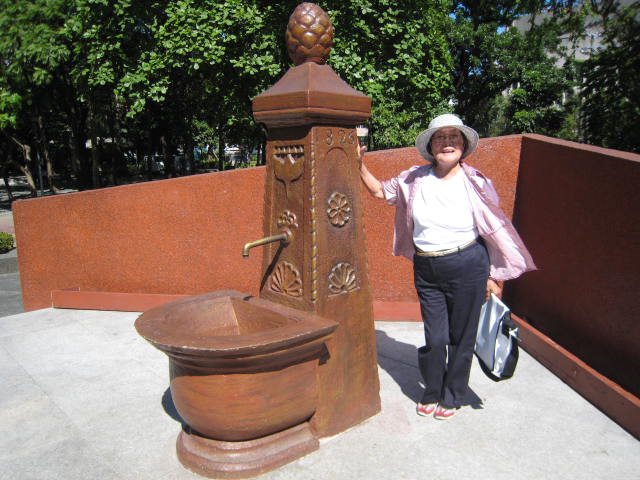
Did you know that right in Luneta, near the Rizal Monument, there's a drinking fountain donated by the people of Wilhelmsfeld, Germany to the Filipino people?   It was used by our national hero, Dr. José Rizal in 1886 when he lived in their small village near Heidelberg.

Background

Recently, I created a very short video about my latest trip to Rizal Park, Luneta, Manila describing this much forgotten Rizal relic titled The Wilhelmsfeld, Germany drinking fountain used by Rizal. I posted it on Facebook.

http://tripwow.tripadvisor.com/tripwow/ta-05b4-62c4-a2b5?share=1&cs=p&lb=1

One cannot believe the deluge of comments I received from Facebook viewers (from around the world including the Philippines, Spain, Italy, Germany, Netherlands, Belgium, Middle East, Canada and several states in the US) wanting to know more about this Unknown Rizal Relic.  Earlier, I also created a four-page Newsletter titled Rizal's Wilhelmsfeld Drinking Fountain in Luneta, Manila. My good friend, Sir Rainer J. Weber, Commander of the Knights of Rizal, Wilhelmsfeld-Heidelberg chapter, requested me to transform that Newsletter into a blog where interested followers could just visit.

So here goes.


You've Never Heard of It, but There's A Living Rizal Relic in Luneta!


Restored in 2011 in time for the Rizal Sesquicentennial

The drinking fountain was installed at Rizal Park in 1964, cleaned and repaired in 1994, and refurbished and painted in 2011.

It's running dry and is non-functional. 

To the teachers of Rizal courses: "Be sure to include this material in your lesson plans."


Totally in the Dark


Why was I never aware of this Rizal's Drinking Fountain till I visited Wilhelmsfeld, Germany in 2011?  Why have I not been taught, throughout my schooling days and throughout my Rizal reading assignments, about the presence of this important historical "Relic" at Rizal Park?   


I pride myself in being a Rizalist yet I have neither known nor read any article about this Fountain.  Have you?  (I'm addressing you, my dear readers and blog followers.) 

Had this Rizal Relic ever gained an inch of print anywhere? Shame! This blog is an attempt to answer this stinging reproach.


A Living Monument


Friday, 27 April  2012.
Rizal Park, Luneta, Manila, Philippines

I arrived from San Francisco on a  PAL direct flight  and checked in at  Manila Hotel.  From there I walked over a block away to Luneta and observed the spiffy Philippine Army’s Special unit in revolutionary rayadillo uniform changing guards at the Rizal Monument. Very Impressive! I met a service park employee and talked to him.


“I came all the way from San Francisco, California to see a special place in Rizal Park. Where’s the Rizal living Monument?”


Park employee:  Patay na po siya. (He’s dead.) 

Me:   Well, isn’t there a drinking fountain where Rizal used?


Park emp.: Oh, yes, over there on that side, po. France donated it.


Me.  Not exactly. Wilhelmsfeld, Germany donated it.


Park emp.: Well, OK, po. It’s a replica.


Me.  Sorry, it’s the original fountain, a living monument."


Note: The Rizal Park 's Tourist Police seems unaware of Rizal’s Wilhelmsfeld Drinking Fountain within their own premises.


A Rizal Park In Wilhelmsfeld, Germany


Wilhelmsfeld is officially Germany’s “Noli Village”   where there’s a Rizal Street and a Rizal Park.  An  expressive-looking freestanding bronze statue larger than life graces a pedestal surrounded by a pool of dancing waters.  This is the only hero’s statue that I know of where one can pose beside it.


 D. José Rizal's statue standing  at ground level.  Wilhelmsfeld Rizal Park.


In this vicarage house,  Rizal finished the last remaining chapters of his novel Noli me Tangere. The simple three floor level vicarage has a Rizal historical marker and a Rizal street sign. The village council and Knights of Rizal chapter celebrate Rizal Day, December 30th  and Rizal's birthday, June 19th yearly.


In Wilhelmsfeld, as a tool for perfecting his German language skills, Rizal read Schiller’s William Tell and started translating it in Tagalog. He finished translating the full play six months later when he moved to Leipzig. 


He created a comic strip in German for Friedrich, Pastor Ullmer’s 13 year-old son. This comic strip is historian Dr. Ambeth Ocampo's favorite Rizaliana.


Rizal learned religious tolerance in Wilhelmsfeld by joining the regular weekly discussions in theology with Pastor Ullmer, the protestant vicar, and the pastor's friend, Father H. Bardoff,  the Catholic priest of the nearby town.


A Historic and Spiritual Experience 


At Luneta’s Rizal Park, Manila, Philippines, one can see great and inspiring memorial statues.  The exception is this fountain. It’s not a memorial. It’s an actual relic.  Only in this fountain can one feel Rizal’s personal aura. Just imagine--he drank from this very spout. He touched this sandstone pillar. With his fingers, he traced the intricate designs inscribed on its sides. He wondered at its symbolism. He noted the date: 1826 and appreciated its old history. He admired the top finial pine cone.  


He actually sat on the trough’s rim and quenched his thirst from this very fountain. 


Wow, Rizal must have cupped his hands to drink fresh spring water at this very spot.
I was eager to see this drinking fountain that Rizal used while he was in Wilhelmsfeld.  Rizal was studying at Heidelberg University doing clinical opthalmology practice with Heidelberg University's Professor Dr. Otto Becker.  During one of  his walks on Philosophenweg, he met Pastor Karl Ullmer of Wilhelmsfeld, a village 13 kilometers away, and found a friend and a landlord.  Moving out of Heidelberg and settling in the village, Rizal would walk that distance (3 hours trek) though the Odenwald forest. When he arrived home exhausted, the most welcoming sight as he entered the vicarage gate was this drinking fountain.  


Don’t miss this historic moment. Get thee to this unique and significant Rizal Park relic in Luneta and savor a monumental and spiritual experience!


How the Fountain Found its Way to Luneta

Penélope with Sir Rainer J. Weber

An Interview with Sir Rainer J. Weber,  Chapter Commander, Knights of Rizal (KCR), Wilhelmsfeld-Heidelberg.  (06-09-2011). 


PVF: Was the drinking fountain a pump... a Philippine rural “poso”?


RJW: No, it wasn’t pumped. It was running water from a nearby well that flowed into the sandstone fountain inside the Pastor’s garden wall for his family to drink and use. It had a lost trough outside the wall for the locals, farmers, and their cattle to use. It had been out of service for many years because the wooden hose system had decayed over time. Since WWII, it had run dry. When a new vicarage entry gate was built, it was moved into the garden with no function except as a decoration.


PVF: Whose idea was it to give it to the Philippines?
Gene Cabrera was a Philippine  artist/ journalist who visited Wilhelmsfeld, 1963.


RJW: It was my father’s guest, the Philippine artist Gene Cabrera who came to visit in October 1963. He eyed the  drinking fountain and realized its historical significance. (See Cabrera's sketch.)


My father, Pastor Gottlob Weber, took on the idea further and convinced the higher Church authorities, who owned the item, to donate it to the Filipino people.  In September 1964, the fountain was shipped off to Manila via Philippine Air Lines. Voluntary contributions poured in. 
Pastor Gottlob Weber and Filipino guests, Wilhelmsfeld,1963.


On December 30th 1964, the fountain was formally handed over to the Filipino people by H. E. von Stechow, the German Ambassador.  Attending were the Ambassador's wife, Minister for Cultural Affairs  Pura Castrence, Mr. Gene Cabrera, Mrs. Mendez and her husband Foreign Secretary Mauro Mendez.


PVF:  How long did the project take?


RJW: It was all a matter of 14 months from the conceptual planning to the Luneta installation.


PVF:  How did your father, Pastor Weber, get involved in all these?


The empty spot where the fountain originally stood inside the vicar's garden, Wilhelmsfeld, Germany.
RJW:  Since Dr. Paz Mendez conducted her Rizal research in Wilhelmsfeld, my father read a lot about Rizal and his works and fell in love with him. Soon many officials and Philippine dignitaries came visiting the vicarage. My dad received them all. He even kept a signature guest book. Of course, when he was invited as a special guest to the Rizal Centennial in 1961, he was all fired up. So when the fountain issue came up he was full of enthusiasm and initiated the project heartily. Neither the Philippine Government nor Mrs. Mendez of the Philippine Historical Commission initiated it.


PVF: He was an extraordinary Rizalist, and so are you as I find us united in spirit with Rizal’s legacy.

RJW: Yes. Thanks.


IN MY HUMBLE OPINION 

Penélope V. Flores 


Walking 500 yards off to the right of the Rizal Monument, I noted the attractive path leading southward to the Rizal Fountain area.  The slightly raised graduated geometric cement platforms give the fountain good visibility. I also like the sloping angles of the background wall. It contributes a solid strong structural dimension to the fountain. It has clean lines. The surrounding crowning trees provide cool shade and help muffle Roxas Boulevard’s street sounds.
The fountain is painted brown umber and  the background wall in burnt sienna.  In my humble opinion, the fountain and the retaining wall have no color separation. From a distance the whole set blurs into one.
I expected an old natural red sandstone fountain, but it was smoothed over with paint that shouted “Look at me, I’m brand new!” Didn’t Rizal actually drink from here in 1886 when the fountain was already 60 years old? (Note the date on the fountain’s side: 1826.) I referred to the 1963 drawing and picture. That fountain definitely had character.  It was naturally ensconced within a bowery garden whereas now, in the renovated site it stands in a garden of concrete.  Inadvertently, I think the 2011 restored fountain suffers a misrepresentation image. 


Anyway, I’m happy. I had seen the Rizal relic. There it is in its full glory. 
I gathered my relatives and friends and gave the fountain’s historical story and then requested them to pass it on. 

The plaque acknowledges the contribution of Wilhelmsfeld to  Rizal Park.
We need to let people know about this true Rizal living artifact. It should not be kept hidden in a veil of ignorance and remain undisclosed for so long.  
It’s encouraging that President Benigno Aquino III gave his National Rizal Day Address on Rizal’s Wilhelmsfeld Drinking Fountain site on 30 Dec. 2011.  Kudos to him since it gained a few inches of print in the news.  However, Isn't it a shame that even the leading Philippine newspapers mis-identified the fountain as coming from Heidelberg when the correct information should have been Wilhelmsfeld!  


It's like saying the Rizal Monument is located at Pasig, not at Manila.


Sad to say, Philippine journalists and newspaper reporters have so little information about this important Rizal Relic.

Here is my humble message to teachers everywhere, Knights of Rizal Chapters, educational institutions, government and private agencies: 

"As an initial outreach initiative, let’s use this venue: Rizal's Wilhelmsfeld Drinking Fountain, to create and promote our Rizal events and community activities. It’s about time we elevate the public’s consciousness.   Maraming Salamat pô."


Excerpts from Chapter 7, Noli me Tángere.  


As you read Rizal’s Noli me Tángere’s Idyll in an Azotea, be aware that he was describing the pastoral scene from his Wilhelmsfeld experience and point of view.

Maria Clara asked Crisostomo Ibarra if he ever thought of her during his sojourn in foreign lands.  Ibarra replied:  

“How could I forget you...always, in Germany in the late afternoon when I roamed through the thick forests peopled with the fantastic creations of her poets and the mysterious legends of her past generations, I recalled your name, and when the villagers, returning from the fields in the distance would sing their popular songs, to me they seemed to harmonize with my inner voices singing for you…” Rizal.  2006. Noli me Tángere,  Lacson-Locsin (trans.)  Q.C.: Ateneo Press, p 45.  

Rizal roamed through the thick forest of the Odenwald while walking from Heidelberg through the valley on to Wilhelmsfeld. From Rizal’s window at the vicarage, he could hear the farmers’ rippling, lusty singing voices returning home from the fields. They would stop in front of Rizal’s house where their cattle would drink from the running water trough.

When I visited the village in 2011, I admired, from a local friendly and welcoming restaurant  “Talblick", the panoramic view of the valley and of the Odenwald forest that Rizal loved.


Penélope’s interpretation of Rizal’s Odenwald forest trek. Oil on canvas. 13 x 18 inches.